

In her power: Why midlife is a woman’s strongest chapter
Did you know? There’s a particular kind of tired that shows up in midlife, and if that’s you, you’re joining a club.
It’s quite a unique thing.
- Not collapse.
- Not crisis.
More of a steady fatigue from doing everything the hard way for a long time.
International Women’s Day got me thinking about strength, the real kind. And midlife has its own version.
So let’s explore it, with a dash of science-nerd energy. (Smile emoji.)
You might have built things. Held things together. Anticipated needs before they were spoken. For many women, this is relatable, right?
But lately, coping feels different. It’s kind of like a metamorphosis. Think of a butterfly emerging from its chrysalis.
And voila. You just might be stepping into midlife woman strength in a new form, just like that butterfly. (Although you’ll live longer.)
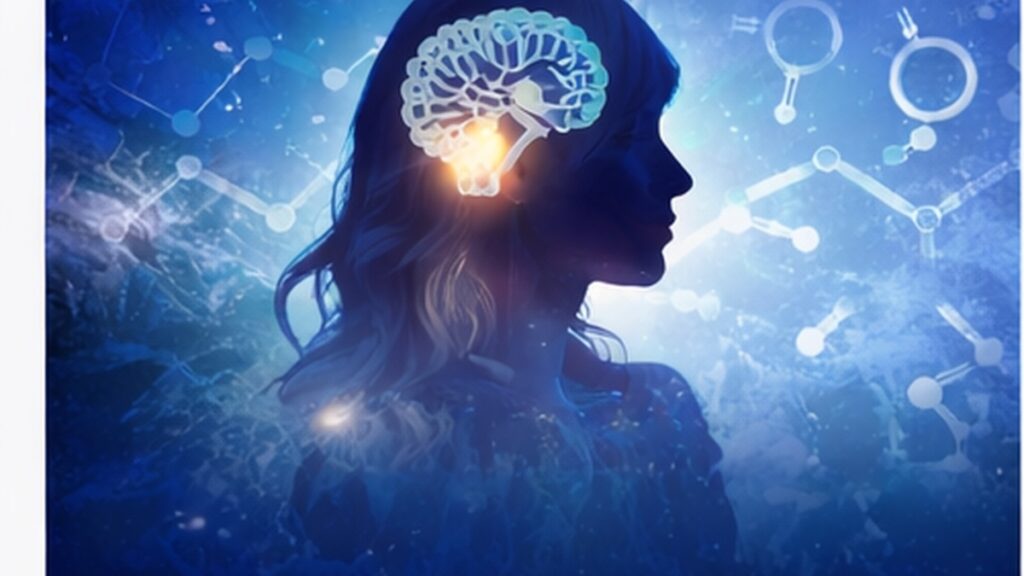
The Midlife Shift Is Biological, Not Personal
It’s super interesting because perimenopause and post-menopause are not just about periods stopping. They’re whole-body transitions.
Estrogen’s an influencer on mood regulation, cognition, sleep, inflammation, and stress response. Indeed, during perimenopause, hormonal levels fluctuate significantly before eventually declining (Santoro, 2016; Harlow et al., 2012). And that fluctuation alone can change how resilient you feel day to day.
Research shows the menopause transition is associated with changes in cognition, mood vulnerability, and stress sensitivity in some women (Greendale et al., 2019; Soares, 2014).
But, to be 100% clear, this is not a weakness.
It’s a physiological adjustment.
And physiology requires a different strategy.

The Midlife Woman’s Hero’s Journey
Every strong woman has chapters.
The Proving Years
In your 20s and 30s, strength looks like endurance.
Do you remember pushing through? Showing up? Delivering? Often for everyone.
Hyper-competence often became our identity. “I’ve got it” became automatic.
And doing it alone felt admirable.
The Reckoning
But then midlife (not just peri and post-menopause) comes along and changes the rules.
Sleep becomes discombobulated. Stress hits sooo much harder. And recovery takes much longer.
At the same time, many women are carrying a significant cognitive and emotional load at home and at work. Research on household labour confirms that women disproportionately carry the “mental load” of anticipating, planning and organising (Daminger, 2019).
And over time, chronic over-functioning can accumulate a physiological cost. (Hands up who’s lived this?!) The concept of allostatic load describes how repeated stress taxes the nervous, immune and hormonal systems (McEwen, 1998; Juster et al., 2010).
And midlife often exposes that cost.
You start asking different questions:
- Why am I carrying this alone?
- Why am I proving something I’ve already proven?
But there’s growth happening throughout this transition.

The Quiet Confidence of Midlife
The interesting thing is that the strength that often emerges in midlife women is rarely loud.
It kind of rolls out.
And research suggests emotional regulation and perspective often improve with age (Stone et al., 2010). Wellbeing across the lifespan frequently follows a U-shaped curve, with many people reporting greater life satisfaction after midlife than during it (Blanchflower & Oswald, 2008). Hooray to that, right?
Socioemotional selectivity theory also suggests that as we age, we prioritise meaning and alignment over external approval (Carstensen, 1999). Which basically explains why we often no longer care so much about what other people think. And that’s liberating.
In practical terms?
- You stop chasing approval.
- You begin choosing yourself.
- You find it easier to say no faster.
And girl, that’s power.
Read: How To Beat Menopausal Mood Changes: Your Mental Health Survival Guide

Letting Go of Doing Everything the Hard Way
Many women build their identity around being capable. For many of us, it’s how we roll.
- If things were hard, you handled them.
- If things were messy, you sorted them.
- If things were overwhelming, you pushed through.
But constant pushing through isn’t the best idea for you.
In fact, studies show perfectionism and chronic self-pressure are increasing cultural patterns (Curran & Hill, 2019). And burnout is now recognised as an occupational phenomenon linked to chronic workplace stress (World Health Organization, 2019).
And guess what? Midlife and menopause are often the point where your old ‘always-relied-on-to-get-you-through strategies stop working.
Read: Tired All The Time? Boost Energy & Beat Menopause Fatigue

Support Is Biology, Not Weakness
Culturally, many women were taught that independence equals strength. Ring any bells?
And biologically, connection is a resilience mechanism.
Indeed, research on female stress responses suggests women are more likely to regulate stress through connection and support, described as the “tend and befriend” response (Taylor et al., 2000). What’s more, meta-analysis studies show social support reduces physiological stress reactivity (Hostinar et al., 2014).
During perimenopause, when hormonal shifts begin, support (and your girl gang) becomes even more important.
Support might look like:
- Working with a menopause-informed practitioner (check out our meno-coaching)
- Adjusting strength training and nutrition
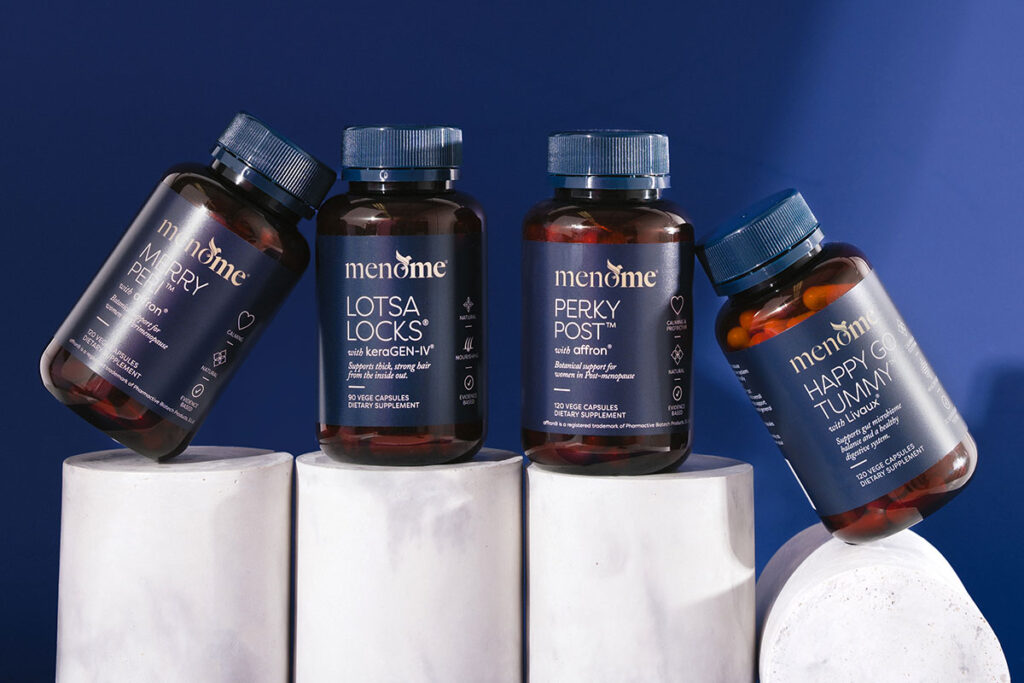
- Evidence-based supplementation such as Merry Peri® and Perky Post®
- Reducing mental load (meditation and breathwork are game-changers)?
- Having heartfelt, honest conversations at home
And this is where peri and post-menopause support and holistic menopause care matter.
At MenoMe®, support isn’t about fixing you. It’s about resourcing you properly for this stage as your on-call wing-women.

Conclusion: In Her (Your) Power
A woman claiming her power at midlife isn’t the one doing everything.
She’s the one making choices carefully.
- She protects her energy.
- She invests in her body.
- She asks for help without an apology.
- And instead of merely acting strong, she starts living it.
So, if you’re tired of doing everything the hard way, that’s not weakness.
It’s feedback.
Midlife and menopause are really a reckoning.
A sharpening up of the woman you are.
And this chapter may well be your strongest yet.
Just so you know: this article is written by a real person who has studied the physiology of menopause and women’s healthy ageing. While we may use AI as an assistant, the research, insights and heart behind every piece comes from us.
Disclaimer: Our articles are a guideline only. Any signs and symptoms you are experiencing could be due to several reasons. For this reason, this should not take the place of medical advice. If you’re experiencing ongoing signs, please see your health professional.
References below.
Share with a friend
Sign up to our mailing list for the latest news and stories and receive a $5 discount code to redeem on your first purchase, plus receive a 3-step eBook on ways to support your body through menopause.
This site is protected by reCAPTCHA and the Google Privacy Policy and Terms of Service apply.
Related Posts




References
Blanchflower, D. G., & Oswald, A. J. (2008). Is well-being U-shaped over the life cycle? Social Science & Medicine, 66(8), 1733–1749.
Carstensen, L. L. (1999). Taking time seriously: A theory of socioemotional selectivity. American Psychologist, 54(3), 165–181.
Curran, T., & Hill, A. P. (2019). Perfectionism is increasing over time. Psychological Bulletin, 145(4), 410–429.
Daminger, A. (2019). The cognitive dimension of household labor. American Sociological Review, 84(4), 609–633.
Greendale, G. A., et al. (2019). The menopause transition and cognition. Obstetrics and Gynecology Clinics of North America, 46(3), 445–457.
Harlow, S. D., et al. (2012). Executive summary of STRAW+10. Menopause, 19(4), 387–395.
Hostinar, C. E., et al. (2014). Social support and stress reactivity: A meta-analysis. Psychological Bulletin, 140(2), 635–675.
Juster, R. P., et al. (2010). Allostatic load biomarkers. Neuroscience & Biobehavioral Reviews, 35(1), 2–16.
McEwen, B. S. (1998). Stress, adaptation, and allostatic load. Annals of the New York Academy of Sciences, 840, 33–44.
Santoro, N. (2016). Perimenopause: From research to practice. Journal of Women’s Health, 25(4), 332–339.
Soares, C. N. (2014). Mood disorders in midlife women. Menopause, 21(2), 198–206.
Stone, A. A., et al. (2010). Age and emotional well-being. PNAS, 107(22), 9985–9990.
Taylor, S. E., et al. (2000). Biobehavioral responses to stress in females: Tend and befriend. Psychological Review, 107(3), 411–429.
World Health Organization. (2019). Burnout is included in ICD-11 as an occupational phenomenon.
