

Did you know that if you’ve reached post-menopause, you’ve cleared a significant marker?
It’s truly a defining moment in your life.
Technically, it begins once 12 months have passed without a period – the point at which you become menopause official.
But here’s what often goes unsaid: post-menopause isn’t an ending. It’s a stage that can last for three decades or more, and it has its own distinct nuances.
For many women, the first feeling is relief. No more tracking, cramping, or wondering.
But alongside that comes a different adjustment – because while the hormonal turbulence of perimenopause often settles, its effects don’t simply switch off.
Symptoms like hot flushes, sleep disruption, and vaginal dryness can continue as the body adapts to lower, more stable estrogen levels.
Indeed, the Australasian Menopause Society notes that these symptoms vary widely and often ease over time – but the timeline is different for every woman.
What’s happening in your body?
During perimenopause, progesterone drops, and estrogen levels can fluctuate dramatically before declining. They don’t go quietly!
In post-menopause, they stabilise at a new, lower baseline and estrone, the form of estrogen that comes into play, is weaker.
That shift matters more than many women are told, because these hormones don’t only govern reproduction. They influence bone density, cardiovascular health, metabolism, brain function, skin and connective tissue, and vaginal and urinary health. In fact, pretty much everything.
But understanding that is less about alarm and more about knowing where to pay attention.

The numbers worth knowing
The average age of menopause is around 51, according to the Australasian Menopause Society.
Around 75% of women experience hot flushes, and roughly one in four find symptoms severe enough to affect daily life.
Perhaps most striking: most Western women spend approximately one-third of their lives in post-menopause (Ministry of Health NZ).
So post-menopause is definitely not a footnote. It’s a life stage that deserves proper attention. Not to mention, a health stage.

Sleep, mood, and the things nobody puts in the brochure
Sleep disruption is one of the most commonly reported experiences in post-menopause. It’s also seriously life-disrupting.
Lower estrogen affects the body’s temperature regulation and can interfere with sleep quality even when hot flushes have reduced. What’s more, as we grow older, we produce less of the sleep hormone melatonin and generally are less tolerant to stress, so our cortisol levels stay higher.
Add in lifestyle factors like drinking wine and caffeine, which can block adenosine, a neurotransmitter that helps us stay asleep – it’s a perfect storm for sleep disruption.
Many women also notice shifts in mood, concentration, or memory during menopause. These aren’t signs of decline; they’re part of a real neurological adjustment. But, and this is important, if they’re persistent or affecting your quality of life, it’s worth a conversation with a GP or menopause specialist.
Eating well after menopause
The food you choose becomes even more important post-menopause, particularly for bone and heart health. In fact, it’s foundational to your life. Research shows that the Mediterranean way of eating is an excellent choice. And this comes out consistently in lifestyle science and the study of the Blue Zones.
It’s built around plenty of fibre from vegetables, fruit, and whole grains, lean protein such as fish or plant proteins, hormone-free chicken and a small amount of red meat, eggs and dairy, perhaps once or twice a week. Pure extra virgin olive oil underpins it, and red wine is in the mix – a small glass always drunk alongside food.
Vitamins and minerals are also important such as the B vitamins, zinc and magnesium. And calcium and vitamin D deserve particular attention because bone density can decline more quickly once estrogen levels drop. It’s a smart idea to get your levels tested.

Movement matters more now, not less
The Australasian Menopause Society and many specialist exercise experts are clear on this: regular physical activity supports bone strength, muscle mass, cardiovascular health, balance, and mental wellbeing in post-menopause.
Strength training is particularly valuable because muscle mass declines naturally with age, and resistance work actively counters that. However, if you’re overweight and don’t have a strong exercise history, it’s not your best bet to start out trying to lift heavy weights.
Instead, try walking, swimming, yoga, Pilates cycling – all of it counts. The goal isn’t performance or becoming an athlete; it’s consistency and feeling good in your body for the long run. Because let’s face it, if you don’t like the exercise you choose, you won’t do it.
Related: 7 Reasons Strength Training Is Vital For Women In Midlife
Supplements: Where They Fit
Food first is always the right starting point, but post-menopause is a stage where certain nutritional gaps are both common and worth addressing directly.
These are the areas most supported by evidence – and relevant to how you feel day-to-day.
Mood, energy and hormonal support: are where many women feel the shift most acutely. We use affron® saffron because it supports mood, emotional wellbeing and sleep, while fenugreek and sage have long been used to support hormonal comfort, including libido and hot flushes.
Vitamin D3 matters more than most women realise, and in post-menopause, even more so. It works beautifully with K2 for bone strength and density and drawing calcium to the bones (and teeth). It also supports immune function and there’s mounting evidence around it for mood and cognitive health.
Cold winters and indoor lifestyles mean deficiency is more common than you might think – a blood test is the best way to know where you stand. In New Zealand this isn’t funded and will cost around $100.
Resveratrol is worth a mention too. This plant compound has emerging evidence around heart health, cellular ageing, and inflammation – areas that can come to the fore once estrogen’s protective effects decline.
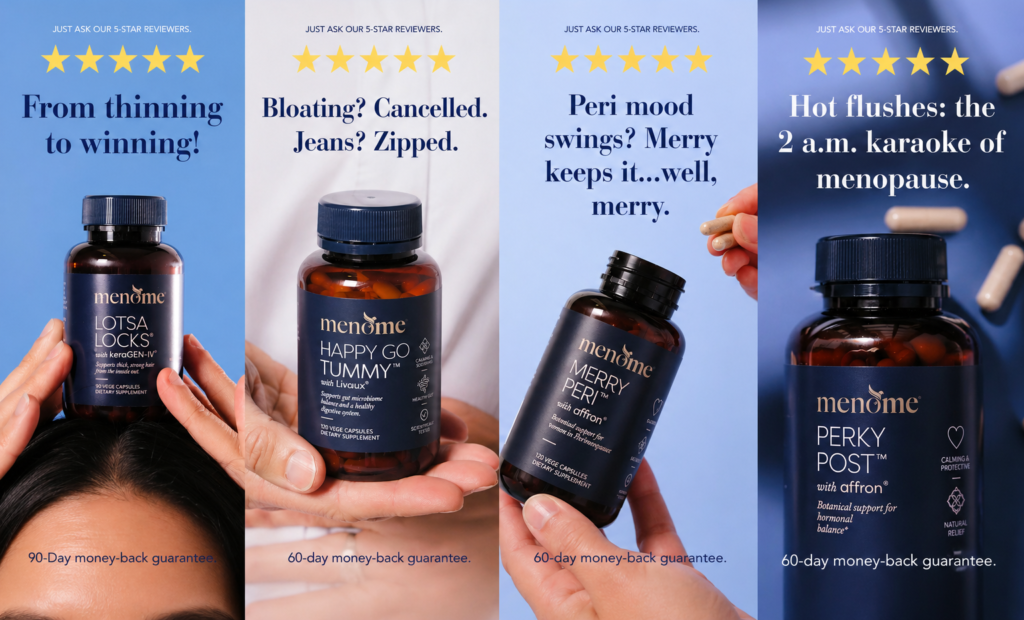
Our Perky Post® brings all of these together – a combination designed specifically for the post-menopause stage, where brain, bone and cardiovascular support become super important alongside mood and vitality.
Hormonal hair thinning is a distressing fallout (pardon the pun!) of menopause. Largely driven by the shift in androgen-to-estrogen ratio, it can affect not just the scalp but texture and density overall. So when we experienced it ourselves we developed LotsaLocks® to address it directly. It combines keraGEN-IV® – an ingestible keratin – with biotin (vitamin B7) to support hair growth and scalp health from the inside out.
Gut health is foundational to the menopause conversations, but that’s not always recognised. The gut microbiome plays a direct role in how the body processes and recirculates estrogen – with a group of microbiome called the estrobolome.
Post-menopause, changes in gut diversity are common and can affect everything from bloating and digestion to mood and immune response. So we developed the Happy Go Tummy® synbiotic — meaning it combines both prebiotic and probiotic support in one formula – containing evidence-backed Livaux®, a gold kiwifruit prebiotic, and Lactobacillus rhamnosus, one of the most well-researched probiotic strains for gut and immune health.
These supplements came about from our own experience and research, so every one of them is evidence-backed and tested by women for women. With that said, as always, if you’re managing specific health conditions or taking medication, it’s worth checking in with your GP before adding new supplements to your routine.
Related: Check out Perky Post® for post-menopause
Conclusion:
A different way of looking at post-menopause
Post-menopause is often framed as loss. Loss of fertility, loss of youth, loss of something. But that’s not how most women describe living it.
Many report greater confidence, sharper priorities, and a genuine sense of freedom – from cycles, from certain anxieties, from other people’s expectations.
The hormonal noise quietens. There’s often more clarity about what matters and less patience for what doesn’t.
That’s not a silver lining offered to soften bad news. It’s what the research reflects and what women consistently say.
Post-menopause, approached with good information and decent support, can be one of the more grounded and purposeful stages of life.
Don’t you just love that?
Questions? Feel free to email me here.
References
- The Australasian Menopause Society — menopause.org.au
- Ministry of Health New Zealand – health.govt.nz
- Best Practice Advocacy Centre NZ – bpac.org.nz
- National Institute on Aging – nia.nih.gov/health/menopause
Just so you know: this article is written by a real person who has studied the physiology of menopause and women’s healthy ageing. While we may use AI as an assistant, the research, insights and heart behind every piece comes from us.