
The Stages Of Menopause Explained (Without The Confusion)
You’ve heard of menopause.
You might even think you’re close to it.
But here’s where it gets a bit murky: What actually is menopause, and where do all the signs and symptoms fit in?
Because most women aren’t “in menopause”. There are “stages of menopause,” Which, by definition, is the end of your fertile years.
So many women are somewhere in a longer transition that starts earlier and lasts longer than many of us knew.
Let’s clear it up.
First, a quick reality check
The menopause stage isn’t a long phase.
It’s one point in time.
You’re officially in menopause when you’ve gone 12 months without a period (Australasian Menopause Society; NHS).
Which means by the time you know you’ve reached it, you’re already in post-menopause.
So, when do all the signs and symptoms we hear so much about happen?
The truth? Mostly before. In perimenopause.
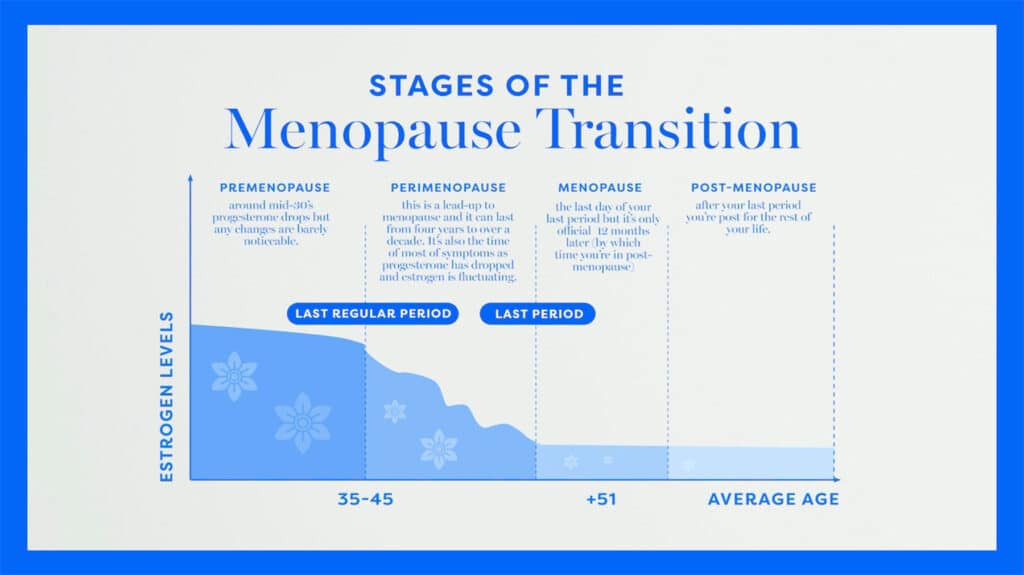
The 3 Stages Of Menopause
1. Perimenopause (the lead-up)
This is where most of the action happens.
Perimenopause means “around or near menopause”, and it’s when your reproductive hormones begin to shift.
It often begins in your late-30’s/40s and can last anywhere from 4 to 10 years, sometimes longer (Mayo Clinic; Australasian Menopause Society).
This is when you might notice
- irregular, lighter or heavier periods
- hot flushes or night sweats
- mood swings
- anxiety
- poor sleep
- brain fog
- bloating or weight changes
- vaginal dryness
- lower libido
- itchy skin
Not every woman experiences all of these. Some barely notice anything.
But for many, this is the stage that feels the most disruptive.
Why?
Because hormones aren’t just declining, they’re fluctuating.
Estrogen can go through big highs and lows, while progesterone tends to decline more steadily. But the process can throw their ratios way off-kilter, which can drive many of the common signs and symptoms (Jean Hailes for Women’s Health).
And your body is trying to keep up with both.

2. Menopause (the moment)
This is the simplest stage, but also the most misunderstood.
Menopause is official when you’ve gone 12 consecutive months without a period (Australasian Menopause Society).
That’s it.
No test neatly tells you perimenopause is about to end and “you’re in post-menopause now” in real time. (Well, not at the time of writing, although bloods can tell you if you’ve reached post-menopause.)
So, it’s typically something you recognise in hindsight.
Which is why many women feel like they’ve been “in menopause for years” when, in fact, they were in perimenopause.
3. Post-menopause (the rest of the story)
Post-menopause is everything after that 12-month mark.
And this stage lasts for the rest of your life.
For many women
- Some signs and symptoms settle
- Others can continue, like hot flushes
What changes here is more about long-term health.
Lower estrogen levels mean increased vulnerability to
- bone loss (osteoporosis)
- heart health changes
- metabolic shifts
- cognitive changes
This is why post-menopause is often described as a key time to focus on prevention and long-term wellbeing (Heart Foundation New Zealand; International Osteoporosis Foundation).
It’s a new baseline that deserves proper support.
What about premenopause?
You might hear this term, but it’s not one to get too caught up in.
Premenopause simply refers to the years before perimenopause, when cycles are still regular, and fertility hormones are more stable.
For most women reading this, the more useful distinction is perimenopause vs. post-menopause.
That’s where your real lived experience sits.
Why this matters more than you think
For years, women have been told “Menopause is when your periods stop.”
Technically true.
But practically, not very helpful.
Because by the time that happens, you’ve often already been dealing with symptoms for years.
Understanding the stages helps you
- recognise what’s happening sooner
- feel less blindsided
- make better decisions about your health
- and you’re not stumbling in like so many of us have
A final word
Menopause isn’t a sudden event; it’s a gradual transition, often with a few rollercoaster rides along the way.
And like any transition, it makes a lot more sense when you know where you are in it. Phew! Because without more understanding, it can be a bit of a minefield.
Some women wonder what all the fuss is about, but for 80% of us, the challenges are real.
Want to know more? We’ve got you. Pour yourself a cuppa, settle in for 40 minutes or so and watch: Menopause – A Conversation We All Need
Disclaimer
This article is intended as a guide and isn’t a substitute for personalised medical advice. If you need further support, please see a qualified professional.
Just so you know: this article is written by a real person who has studied the physiology of menopause and women’s healthy ageing. While we may use AI as an assistant, the research, insights and heart behind every piece comes from us.